The Small Business SEO Checklist for 2026

The Small Business SEO Checklist for 2026
Search engine optimization sounds intimidating, but the fundamentals are not complicated. If you run a small business in Wenatchee, Moses Lake, Yakima, or anywhere in Central Washington, this checklist covers the SEO basics that will help your website show up when local customers search for what you offer.
You can work through this list yourself or use it as a guide when hiring someone to help. Either way, tackle these items in order. Each one builds on the last.
Part 1: On-Page SEO (The Content on Your Website)
1. Every Page Needs a Unique Title Tag
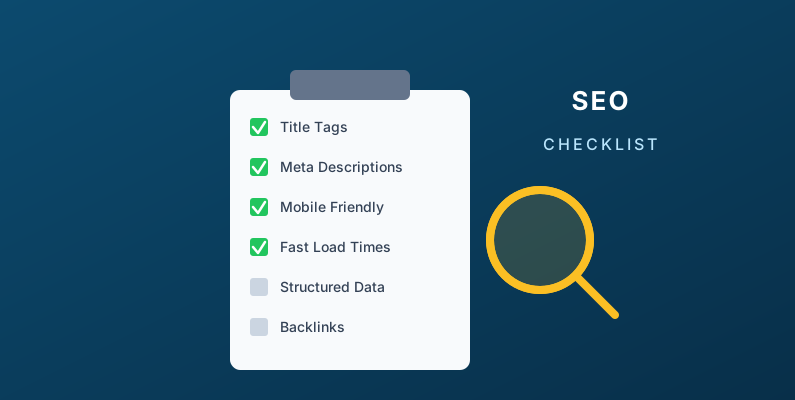
Your title tag appears as the clickable headline in Google search results. Every page on your site should have a unique, descriptive title between 50 and 60 characters. Include your main keyword and your city or service area.
Example of a bad title: "Home" Example of a good title: "Wenatchee Web Design | Columbia Valley Web Designs"
2. Every Page Needs a Unique Meta Description
Meta descriptions appear under the title in search results. They do not directly affect rankings, but they affect whether people click. Write a compelling 150-160 character description that includes your keyword.
3. Use One H1 Per Page
The H1 is the main heading on a page. Google uses it to understand what the page is about. Every page should have exactly one H1, and it should describe the page content clearly.
4. Use H2 and H3 for Subheadings
Proper heading hierarchy helps both Google and human readers. Structure your pages like an outline: H1 for the main topic, H2 for major sections, H3 for subsections.
5. Write for Humans First
Google is smart enough to penalize keyword-stuffed content. Write naturally for your customers. Include your keywords, but only where they make sense. If a sentence reads badly, rewrite it.
Part 2: Technical SEO (The Foundation)
6. Your Site Must Be Mobile-Friendly
Google indexes the mobile version of your site first. If your site does not work on phones, you are invisible in mobile search. Test your site at search.google.com/test/mobile-friendly.
7. Your Site Must Be Fast
Core Web Vitals are a direct ranking factor. Run your site through Google PageSpeed Insights. Aim for a mobile score of 90 or higher. If you are below 70, speed is actively hurting your rankings.
8. Use HTTPS
Every website should be served over HTTPS (the padlock in the browser bar). Sites without it are flagged as "Not Secure" and pushed down in rankings. Most hosting providers offer free SSL certificates through Let's Encrypt.
9. Submit a Sitemap to Google
A sitemap tells Google what pages exist on your site. Create one (most modern platforms do this automatically) and submit it through Google Search Console.
10. Set Up Google Search Console
Google Search Console is free and essential. It shows you which searches bring visitors to your site, which pages are indexed, and any technical issues Google has found. Set it up as soon as your site is live.
11. Add Structured Data
Structured data (also called schema markup) is code that tells Google exactly what your business does, where you are located, what your hours are, and more. Add LocalBusiness schema for your contact page and FAQPage schema for any pages with questions and answers.
Part 3: Local SEO (Critical for Central Washington Businesses)
12. Claim Your Google Business Profile
Your Google Business Profile is free and it is the single most important local SEO tool. Claim it, verify it, and fill out every field. We covered this in depth in our Google Business Profile setup guide.
13. Ensure NAP Consistency
Your Name, Address, and Phone number must match exactly everywhere online — your website, Google Business Profile, Yelp, Facebook, every business directory. Even small differences like "St" versus "Street" can confuse Google.
14. Create Location Pages
If you serve multiple cities (Wenatchee, Moses Lake, Yakima, etc.), create a dedicated page for each one. Each page should have unique content about that specific city — local landmarks, local industries, local testimonials if possible.
15. Get Google Reviews
Reviews are a top-three local SEO factor. Ask every satisfied customer to leave a Google review. Respond to every review within 48 hours. Aim for two to four new reviews per month, consistently, rather than a single burst.
16. Get Listed in Local Directories
Chamber of Commerce memberships, Better Business Bureau, Yelp, and industry-specific directories all help your local visibility. Each consistent NAP listing is a local SEO signal.
Part 4: Content SEO (The Long Game)
17. Publish a Blog
A blog gives you pages to rank for all the searches your potential customers are making. Educational content like "How to choose a contractor in Wenatchee" can bring in traffic that converts to leads over time.
18. Target Long-Tail Keywords
You will not outrank Home Depot for "home renovation." But you can rank for "kitchen remodel contractor in East Wenatchee." Long-tail keywords (three or more words) have less competition and higher conversion intent.
19. Update Old Content
Google favors fresh, regularly-updated content. Review your existing pages twice a year. Update statistics, add new information, improve weak sections. A small update on a blog post from two years ago can bring it back to page one.
20. Build Internal Links
Every blog post and service page should link to other relevant pages on your site. Internal links spread authority, help Google discover content, and keep visitors on your site longer.
Part 5: The Advanced Stuff
21. Build Backlinks From Local Sources
Backlinks from other websites are still a major ranking factor. For local businesses, the best backlinks come from local sources: Chamber of Commerce, local news (Wenatchee World, Columbia Basin Herald), community sponsorships, partner businesses. Avoid paid link schemes — they can hurt more than help.
22. Monitor Your Rankings
Use free tools like Google Search Console to track which searches bring traffic to your site. For more detailed rank tracking, tools like Ahrefs, Semrush, or Ubersuggest offer free tiers.
23. Watch Your Competitors
Pay attention to what other businesses in your market are doing online. What keywords are they ranking for? What content are they publishing? You do not need to copy them, but understanding the landscape helps you identify gaps.
Where to Start
This is a lot. Do not try to do it all at once. Here is the priority order:
Week 1: Items 1-5 (on-page basics), 12 (Google Business Profile) Week 2: Items 6-11 (technical foundation) Week 3: Items 13-16 (local SEO) Ongoing: Items 17-23 (content and backlinks)
If your website was built on a page builder, is slow, or is not mobile-friendly, no amount of SEO work will compensate for a weak foundation. In that case, the highest-impact move is rebuilding on faster infrastructure first.
Need Help?
Every website we build at Columbia Valley Web Designs includes items 1-11 as standard — on-page SEO, technical SEO, mobile-friendly design, fast load times, HTTPS, sitemaps, and structured data all handled before launch. You get the foundation; we teach you the rest.
Get a free estimate for a website built with SEO done right from day one.